Luxury Tiger Chair: how it settles into your living room

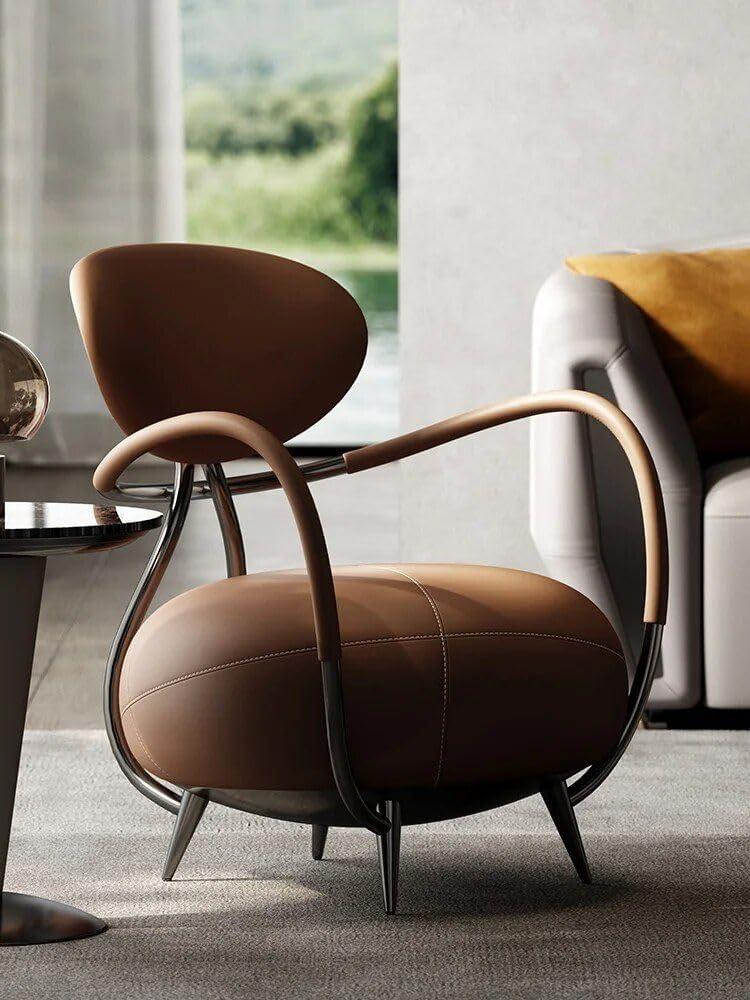
Light skimming the leather makes the surface come alive — a muted pebble grain with a faint sheen where the sun hits. You notice the Luxury Tiger Chair, called an Italian minimalist leather leisure chair on the tag, and the name fits the understated, almost sculptural shape. Under your hand the seat gives a speedy, resilient rebound; seams are tight and the frame feels cool and taut beneath the upholstery. At single‑chair scale it carries surprising visual weight, a compact presence that reads as a finished, unbroken form rather than a collection of parts. Moving around it, you keep finding small details — the way edges catch light, the soft resistance of the foam — that mark it as lived‑in rather than staged.
What you notice first about the Luxury Tiger Chair when it arrives in your living space
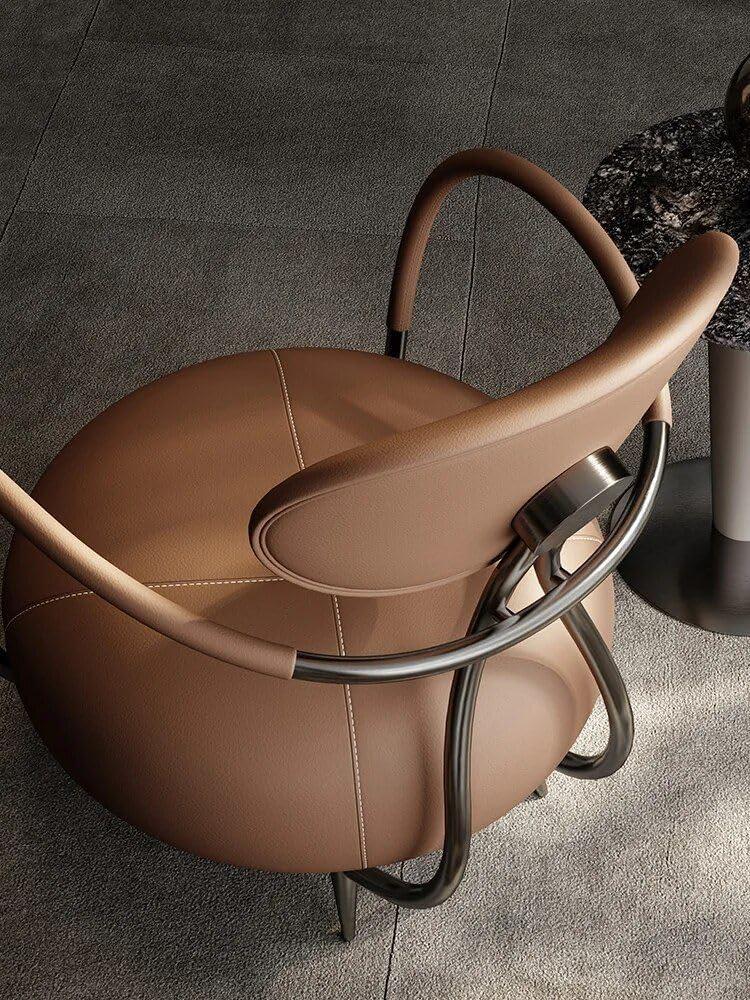
When the chair arrives and you set it down in your living space, the first thing you notice is its presence — how it occupies a corner of the room and draws the eye. the silhouette reads immediately against other furnishings: compact but unmistakable, with clean lines that catch the light differently across its surfaces. From certain angles the surface looks almost satiny; from others the texture deepens, revealing stitched seams and subtle contours where the cushions meet the frame. The chair’s scale in relation to your coffee table or sofa becomes obvious within seconds, and you find yourself stepping back and forward to gauge how much visual space it takes up.
Closer up,your attention shifts to small,habitual interactions: you smooth a cushion edge,run a hand along a seam,and notice the give where you press into the seat. The leather tends to show fingerprints and the surface changes slightly as you adjust the back or settle in, so the chair seems to arrive in a state of quiet adjustment — it settles into the room and into use over a short while. For a few minutes you’ll likely nudge its feet, straighten a seam, or turn your head to see how light plays across it at different times of day
How its Italian minimalist silhouette reshapes the light and lines of your room
When you first look at it in the room, the chair’s pared-back profile redirects attention more than it dominates the space. Its low, uncluttered lines let light skim across the leather in long, narrow ribbons; at certain angles the metal base picks up thin points of reflection that trace a faint highlight across the floor. Because the form keeps mass close to the seat,the surrounding vertical and horizontal planes—walls,windows,the edge of a rug—read as longer or cleaner,not interrupted by a bulky silhouette. The rounded back and gently sloping arms break the room’s right angles just enough to soften the geometry without creating a new focal knot.
As you sit or shift, the chair alters that conversation between light and line. Cushions compress and seams flatten,sending subtle changes in shadow across the seat; a small crease will catch a slant of afternoon sun while the slender legs throw thin,legible shadows that seem to lift the chair off the floor.The minimal form also tends to reveal more of what’s behind it — wall texture, floor grain, a low table — so the chair can read as part of the room’s composition rather than an enclosed object. In dimmer light those same metal highlights become pinpoint accents; in brighter conditions, the negative spaces framed by the arms and base feel more pronounced, giving the room a slightly more open rhythm than a bulkier piece would produce.
The leather, stitching and frame details you can read up close
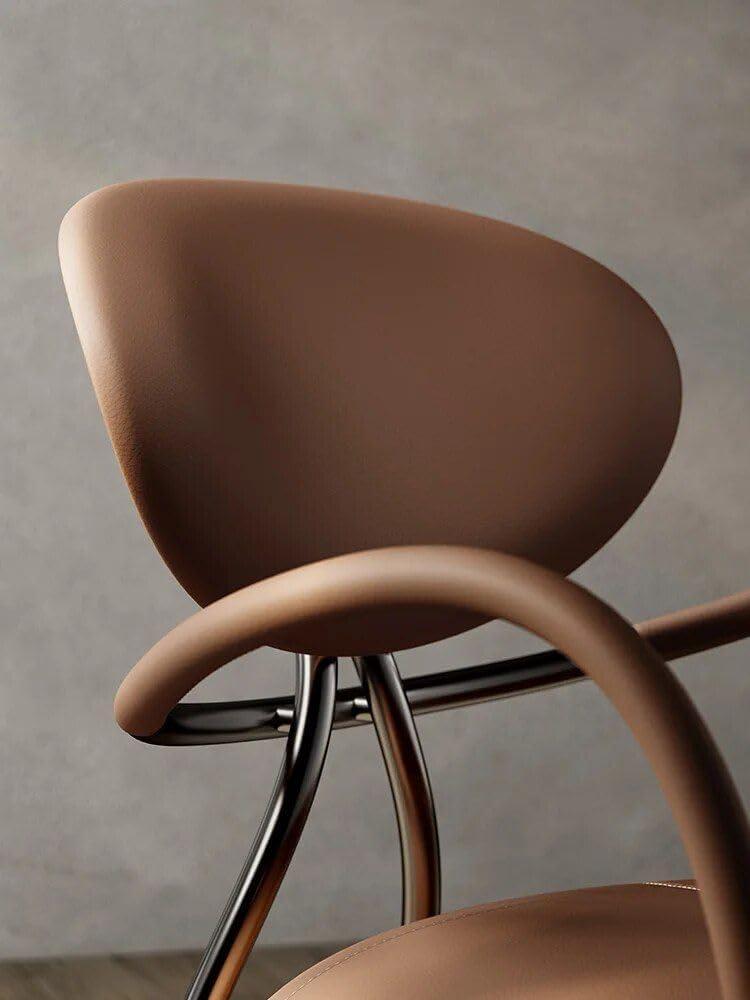
Up close, the leather reads as a worked surface rather than a flat finish: when you run your hand along the seat it catches the light in faint, uneven sheens and the grain shows tiny, irregular creases where the foam yields beneath you.Small indentations appear where you settle, and those marks tend to linger a little before smoothing back as you shift; the surface warms under your palm and the texture becomes more pronounced along the areas you touch most often — the head of the backrest and the outer edges of the seat.
The stitching frames those surfaces in a practical, visible way. Seams follow the chair’s silhouette and, when you lean or adjust your position, the thread pulls slightly taut and the stitch lines can form shallow channels that guide the leather’s folds. There’s a consistent stitch spacing along the main joins and occasional tiny puckers where panels meet; you’ll notice these more if you press the seam or smooth the cushion. Small, unconscious gestures — brushing lint off the arm or straightening the seat — are enough to make the stitches and edges sit differently from one moment to the next.
| Visible detail | How it appears in use |
|---|---|
| Stitch type | Even, top-stitched seams; slight tension visible when you sink into the cushion |
| Thread colour | Close to the leather tone; contrast shows only under radiant light or when you smooth the panels |
| Edge finish | Rolled and finished edges that sit neatly until you tuck or shift the cushion |
The frame elements that meet the upholstery are most readable at the joins: where the cover wraps around the base you can sometimes spot a narrow gap or a line of compression, especially after someone has been sitting for a while. If you nudge the chair to reposition it, the lower rails reveal themselves through a slim shadowing under the upholstery and you can feel a firm boundary beneath the leather when you press down. Those contact points show light wear more quickly than the broad surfaces, and fingerprints or brief scuffs can appear after repeated handling, then soften with a wipe or gentle movement.
Seating proportions and measurements that describe how you sit and how it occupies your scale
When you settle into the chair it becomes clear how its proportions shape your posture. The seat accepts your pelvis a little rearward of center, so your spine tilts against the backrest and your knees tend to sit level or slightly lower than your hips. The back is tall enough to support your lower and mid back while leaving your shoulders free; you often find yourself slipping a hand between your lower back and the upholstery to smooth a seam or to adjust the cushion. Movement is absorbed across a relatively wide seat plane rather than concentrated in a narrow pocket,and when you shift your weight the foam rebounds quietly beneath you.
Seen from the room, the chair occupies a compact footprint but reads as a low, anchored presence. From the moment you sit, the relationship between seat depth, seat height and back angle dictates whether you plant your feet flat or curl up; small unconscious habits—sliding forward to reach a coffee table, tucking a leg onto the seat, or plumping the cushion—change how much of your body is visible to the room. These lived proportions tend to vary slightly with movement and time on the chair, so the way it fills your personal scale is experienced rather than fixed.
Approximate in-use measurements (experienced,not factory specs)
| Measurement | Typical feeling when seated |
|---|---|
| Seat height ~38–42 cm | Your feet generally reach the floor; knees are neutral or slightly lower than hips |
| Seat depth ~52–58 cm | You sit with hips set back; small forward shifts are common to read or use a laptop |
| Back height above seat ~40–50 cm | Lower and mid-back contact is constant; shoulders remain free to move |
| Footprint ~0.6–0.9 m² | Reads as compact in a room while appearing visually substantial when occupied |
How the chair stands up to your space and everyday expectations
In day-to-day use the chair tends to read as a purposeful, self-contained object in a room: it arrives ready to sit in, so the first interaction is immediate and physical rather than assembling pieces. Placed against a low-profile sofa or beside a side table, it keeps a steady presence—people will notice the way cushions compress slightly under weight and then rebound,and they will habitually smooth the surface or shift a seam after prolonged sitting. As the frame and shell are intact from delivery, moving the piece around frequently enough requires lifting rather than disassembling, which can make tight corners and narrow doorways a practical consideration during placement. On different floor surfaces it behaves differently: it stays put on denser rugs, can settle into softer pile, and may slide a little on slick floors when someone rises or repositions.
Routine use reveals small, human habits more than dramatic changes. With repeated sitting the center of the cushion can feel a touch softer over time while edges retain shape, and occasional nudges to tuck or flatten the cover become part of weekly upkeep. Seams and stitching show minor shifts with movement, and fingerprints or light creasing appear with contact but usually smooth out when rubbed. The chair tends not to rock or squeak; rather it responds in subtle micro-movements as people shift weight or reach for a side table. For most households the everyday picture is one of gradual, lived-in change rather than sudden wear, with simple, repeatable interactions—smoothing, adjusting, sliding—shaping how it fits into routines.
| Typical moment | Observed behavior |
|---|---|
| Morning coffee, quick sit | Immediate comfort; slight give that rebounds quickly |
| Longer reading or TV sessions | Center softens a bit over time; cushions respond to repositioning |
| Rearranging furniture | Requires lifting through tight spots; keeps orientation once placed |
View full specifications and available options
Where you tend to place it day to day across your villas and living rooms
You tend to place the chair where daily life naturally pauses: close to a sunlit window for a morning cup,at the edge of a conversation grouping in the main living room, or tucked into a quieter corner in a villa wing where you settle with a magazine. It often sits slightly angled rather than squared off, as if someone has just risen from it; you’ll notice the leather smoothed by a habitual hand and the cushion nudged a few centimetres forward after someone has shifted to lean back. In open-plan rooms it frequently becomes a simple border between zones, while in smaller parlors it stands alone, more of a single-seat destination than part of a set.
| Space | Typical day-to-day spot |
|---|---|
| Main living room | Beside a sofa or coffee table,slightly angled toward the centre of activity |
| Reading nook / secondary sitting room | Near a bookcase or lamp,frequently enough pulled a little closer to the light source |
| Villa terrace / covered porch | Facing outward to the view or set back under shade,left in place rather than moved frequently |
Over time you notice small,unconscious rituals around it: you adjust the seat back after someone rises,you smooth a seam before sitting,and occasionally you turn it a fraction to follow late-afternoon sun. For some rooms it stays permanently positioned; in others it moves between common spots depending on the day’s traffic and the moment you need a quiet seat.
A Note on Everyday Presence
Living with the Luxury Tiger Chair: Italian Minimalist Leather Leisure Chair for Living Room and Villas Single Chair, you notice how it slows into the room’s rhythm over time — the cushions relax, the leather softens where hands and bodies meet, and it quietly claims a corner in the daily flow. In regular household rhythms its comfort becomes part of ordinary moments, the way a seat responds after repeated evenings reading or watching, and small surface wear marks trace those routines rather than stand out. As the room is used it changes how space is lived in — a landing place for a coat, a pause between tasks, a habitual perch — and it moves from object to everyday presence. It stays.
As an Amazon Associate I earn from qualifying purchases.